There are places that catch you off guard. Monuments that look nothing like what you’d imagine, that appear out of nowhere and — despite that, or perhaps because of it — become the highlight of a trip. Seville’s Métropol Parasol is one of them.
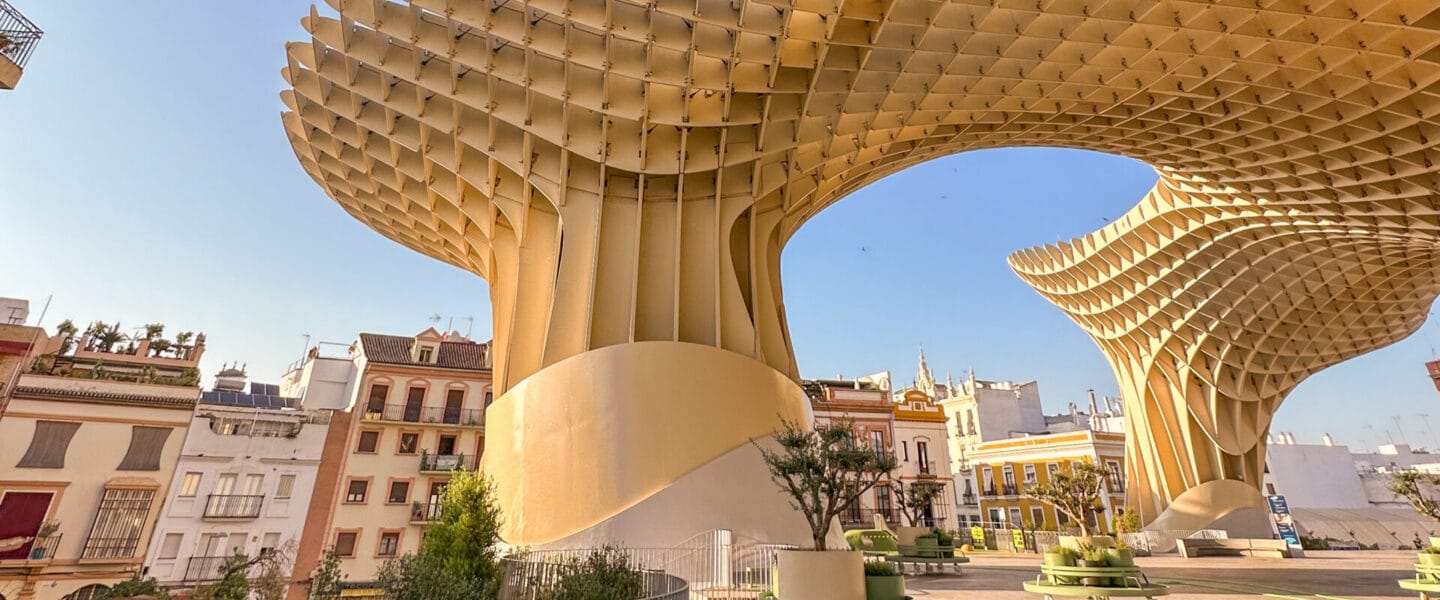
Arriving at the Plaza de la Encarnación, you see them immediately: the mushrooms. That’s what they’re called here, las Setas. Three undulating wooden structures rising from the ground as if about to take flight. Nothing like the medieval Seville of the Cathedral or the Alcázar. And yet, it’s love at first sight.
Las Setas in Seville: an architecture that tells a story
The Métropol Parasol isn’t just a 2010s building placed there by chance. It’s the result of a bold choice. When the city decided to redevelop this square, it launched an architectural competition. Jürgen Mayer, a German architect, won. But here’s the twist: while excavating the ground to build a car park, the teams unearthed the remains of a Roman settlement. Rather than ignoring the discovery, Mayer chose to celebrate it.
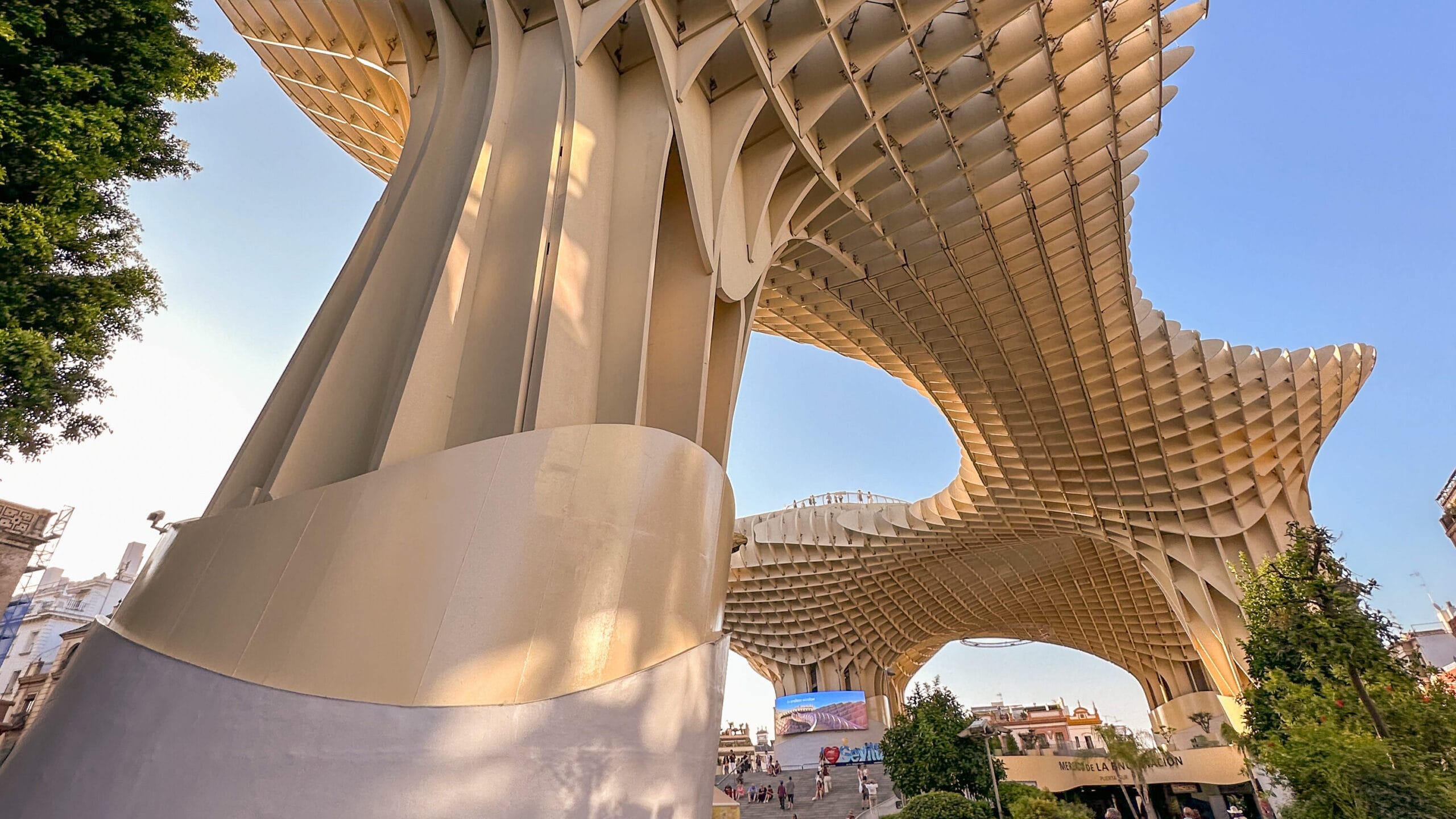
A complex lattice of interlocking beams creates waves, curves, and a living architecture. Nothing rigid, nothing cold — organic geometry inspired by Andalusian textile patterns.
And below? The Antiquarium: an underground archaeological museum where one descends 5 metres to discover Roman mosaics and remains from the first century AD. The past, breathing beneath the feet of present-day visitors.
Day, sunset, night: three ways to experience las Setas
By day
At midday, the curves of the wood cast moving shadows across the square. From the pedestrian walkway El Mirador, Seville unfolds in its entirety: the Cathedral in the distance, the terracotta rooftops of Barrio Santa Cruz, and all that urban chaos that suddenly makes sense from above. It becomes clear why Jürgen Mayer felt it was worth being here.
At sunset
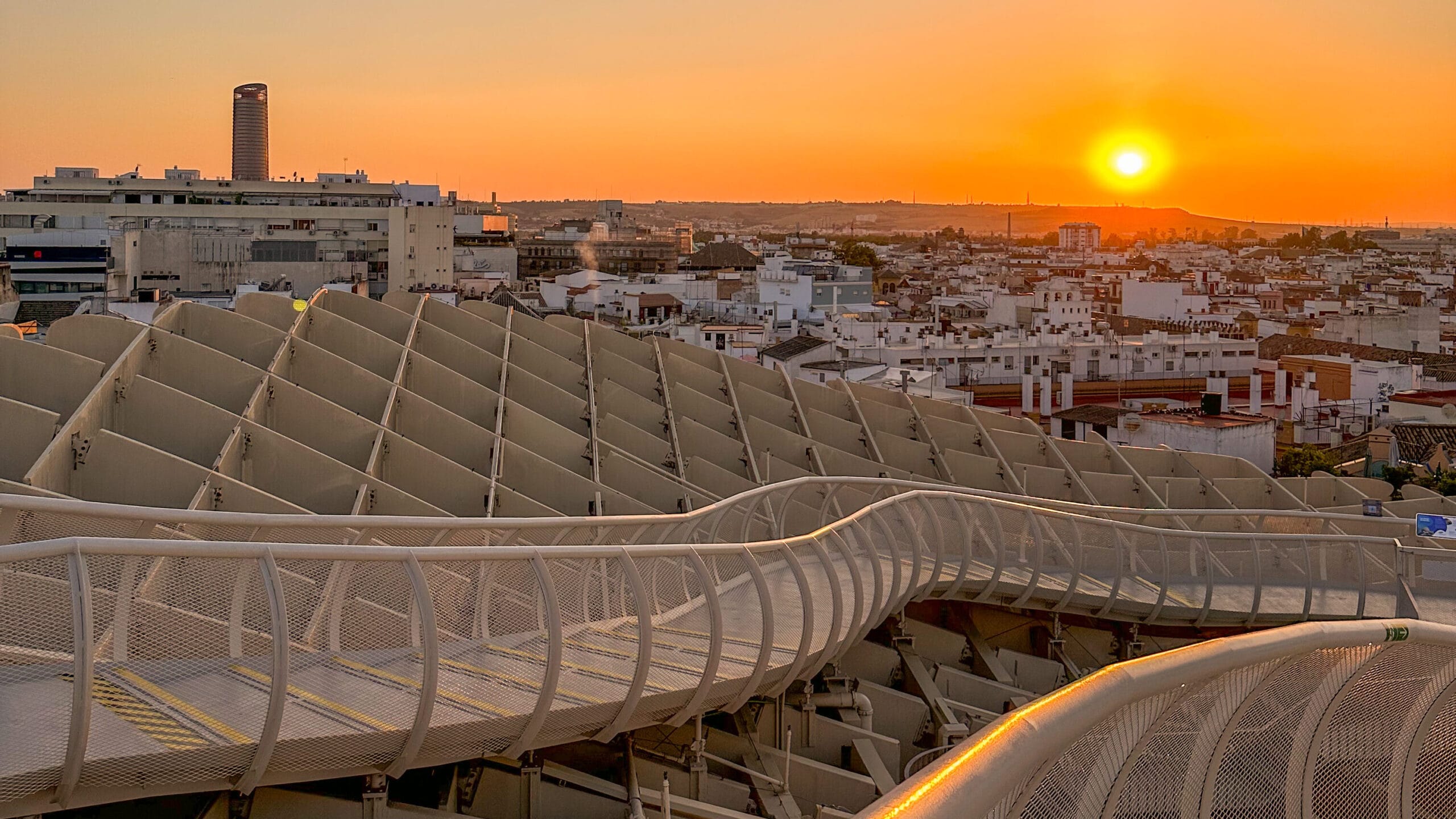
The sun changes everything. The warm wood shifts to orange, then pink. Shadows lengthen. This is the moment one truly understands why the detour was worth it. There’s something deeply magical about watching an unfamiliar city transform in the golden hour. The Métropol Parasol becomes a privileged viewpoint — not a tourist attraction, but an invitation to pause.
It’s also when the bars begin serving their first drinks, a cerveza in hand as the sun disappears behind the Andalusian skyline.
At night
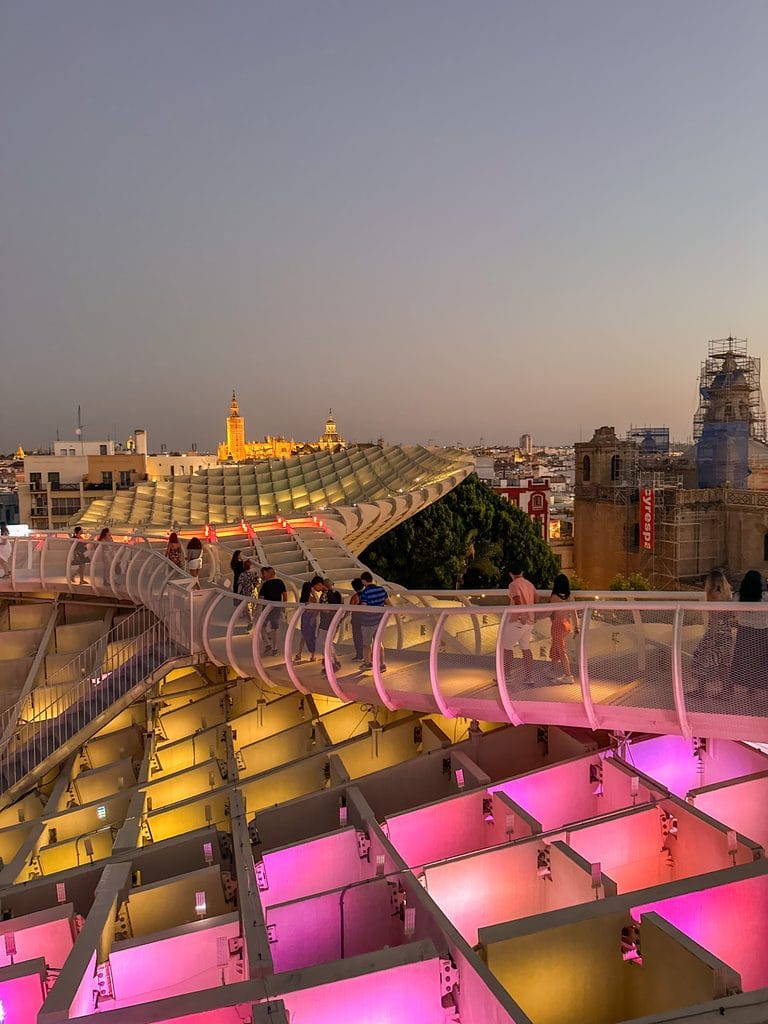
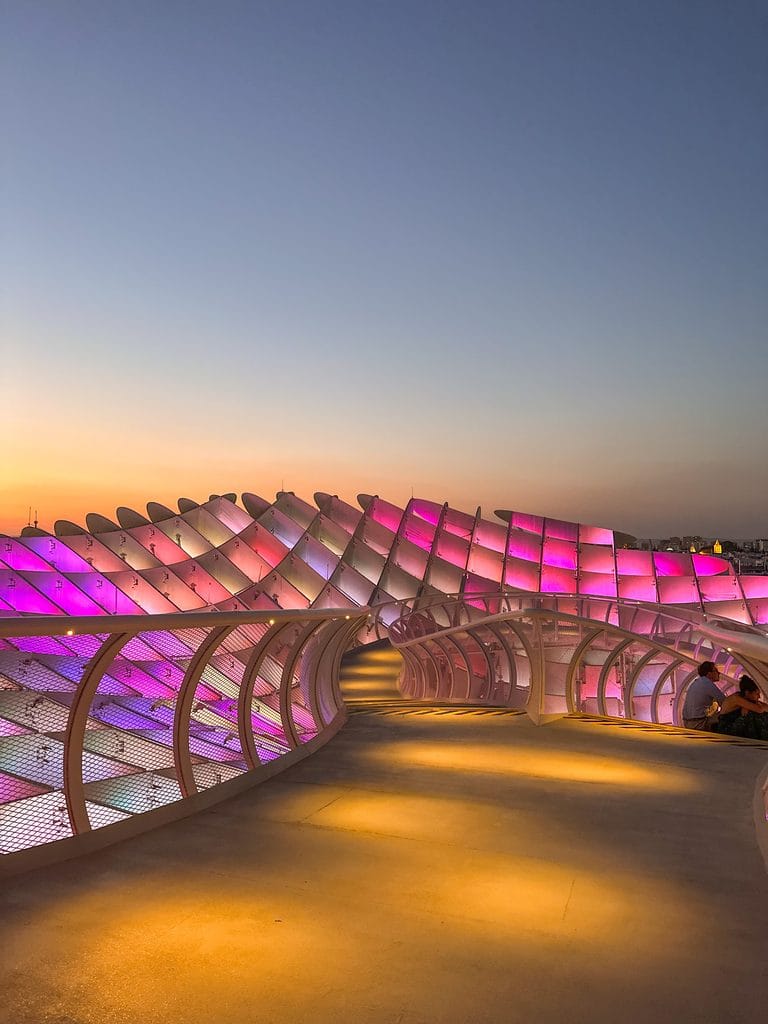
The Métropol Parasol reinvents itself once more. A lighting system highlights every curve of the wood. The mushrooms become nocturnal creatures — surreal, almost futuristic. A deliberate contrast: the ultra-modern vibrating with light, while all around, sleeping churches and palaces hold their silence.
The square shifts mood. Bars become meeting points. The shadows of the structures are cast onto the cobblestones like abstractions. It’s remarkable that a single building can offer three such different experiences.
Why Métropol Parasol is a must-see in Seville
What makes the Métropol Parasol so compelling is that it makes no attempt to be a historical marvel. It embraces being a 21st-century structure while engaging in dialogue with the Roman past resting beneath its feet. Bold without being arrogant — a wooden structure in a city of stone, and it’s precisely that tension that creates an unexpected beauty.
And there’s one more thing: one can explore its history by descending into the Antiquarium, eat in its restaurants, drink on its terrace. This isn’t just a building to photograph. It’s a place where one truly lives.
Practical information for visiting Métropol Parasol in Seville
The site is located on the Plaza de la Encarnación, easily accessible by metro (line 1) or bus (lines 27 and 32). It fits naturally into a route combining Barrio Santa Cruz and the Cathedral.
- Price: €16 (panoramic view + immersive room + Aurora Lighting)
- Children: free up to 5 years old
- Our tip: one hour in the morning, a drink at sunset on the terrace, and one last visit at night when the lights come on.
Discover our complete Seville travel guide →